
If you’ve ever tried to research which veterinary practice is the right fit for your pet, you’ve likely come across the term “AAHA accredited.” It appears on practice websites, waiting room plaques, and Google profiles — but what does it actually mean, and should it influence your decision?
The short answer: yes, it should. Here’s why.
What AAHA Is
The American Animal Hospital Association (AAHA) is a professional organization that sets voluntary standards of care for veterinary practices in the United States and Canada. Unlike state licensing — which establishes a minimum legal threshold for operating — AAHA accreditation represents a significantly higher standard, achieved through a rigorous evaluation process that practices opt into voluntarily.
AAHA was founded in 1933 and has been setting standards in companion animal medicine for nearly a century. Their standards are developed and regularly updated by committees of veterinary specialists, reflecting current evidence in clinical care, hospital management, and patient safety.
What the Accreditation Process Actually Involves
To become AAHA accredited, a practice must undergo a comprehensive on-site evaluation by a trained AAHA consultant. This evaluation assesses the practice against more than 900 individual standards across every area of hospital operation. The evaluation is not a self-reported survey — it involves physical inspection of facilities, review of protocols, assessment of equipment, and evaluation of medical records.
Standards evaluated include:
- Patient care — History-taking, physical examination protocols, diagnostic workup standards
- Anesthesia and patient monitoring — Equipment, monitoring protocols, pre-anesthetic evaluation requirements
- Surgical protocols — Sterile technique, facility standards, patient preparation and recovery
- Pain management — Assessment, prevention, and treatment of pain across patient types and procedure types
- Diagnostic imaging — Equipment quality, safety protocols, image quality standards
- Laboratory services — Equipment calibration, quality control, result interpretation standards
- Pharmacy management — Drug storage, dispensing protocols, controlled substance handling
- Medical record quality — Completeness, accuracy, accessibility, and retention
- Emergency preparedness — Equipment, medications, and team readiness for critical situations
- Client education and communication — Informed consent, discharge instructions, follow-up protocols
- Staff training and continuing education — Ongoing professional development requirements
- Team wellbeing and workplace culture — A relatively newer focus area in AAHA’s standards, reflecting growing attention to veterinary workforce health
Accreditation is not a one-time achievement. Practices must be re-evaluated regularly to maintain their accredited status, meaning the standard must be consistently upheld — not met once and forgotten.
How Rare It Actually Is
Fewer than 10% of veterinary practices in the United States and Canada are AAHA accredited. This is not because most practices are providing inadequate care — it’s because the process requires significant investment of time, resources, and commitment to continuous improvement. Many excellent practices simply haven’t pursued accreditation.
But the rarity of the distinction means that when a practice holds it, it represents a genuine, verified commitment to operating at a higher standard.
What AAHA Accreditation Means for Your Pet, Practically Speaking
When you bring your pet to an AAHA-accredited practice, several things have been independently verified:
The anesthetic monitoring equipment works and is used appropriately. There is a protocol for pre-anesthetic evaluation. A trained team member monitors your pet continuously during any procedure under anesthesia. Pain is assessed and managed — not just during procedures, but as part of every patient encounter.
The diagnostic equipment meets quality standards. Medical records are complete and accurate. Emergency medications and equipment are present and maintained. The team has undergone continuing education in current standards of care.
None of these things are guaranteed simply because a practice is open and licensed. AAHA accreditation provides the independent verification that these standards are being met.
Questions to Ask When Choosing a Veterinarian
AAHA accreditation is a meaningful signal, but it’s one piece of a larger picture. Other questions worth asking when evaluating a practice:
- Is the practice independently owned or part of a corporate group? Ownership model can affect how clinical decisions are made and how the practice prioritizes patient care versus revenue targets.
- What is the ratio of credentialed veterinary technicians (LVTs, CVTs, RVTs) to patients? More credentialed technical staff generally means more thorough care at every visit.
- What diagnostic capabilities are available in-house? Practices with on-site laboratory, digital radiography, and ultrasound can provide faster, more complete workups than those that send everything out.
- How does the practice handle pain management? Ask specifically — pain assessment and management protocols vary widely and significantly affect patient welfare.
- What surgical capabilities are available? If your pet may ever need surgery, knowing what the practice can handle in-house versus what requires referral is important.
Copake Veterinary Hospital’s Accreditation Commitment
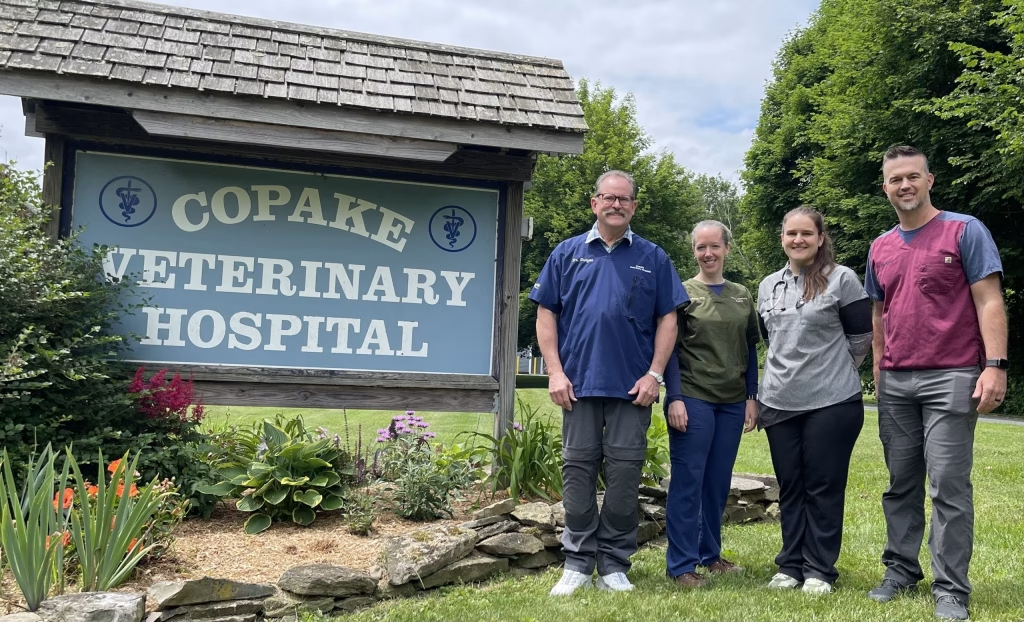
Copake Veterinary Hospital in Copake Falls, NY is proud to be AAHA accredited — a distinction we maintain because we believe our clients and their pets deserve independently verified evidence that our standards of care are real, not just stated. Combined with independent ownership, five Licensed Veterinary Technicians, and a growing surgical capability, our accreditation reflects a genuine commitment to being the kind of practice this community deserves.
If you’re looking for an AAHA-accredited veterinarian in Columbia County, we’d be glad to welcome you. Learn more about our practice or call us at (518) 329-6161 to schedule an appointment for your dog or cat.